Reflections on presenting undergraduate research
Notes from LabPhon20 and Methods XIX
This post is connected to a SSHRC-funded project (grant no. 430-2024-00159) examining how lexical statistics can be explored to generate a baseline for comparison with experimental data. Armand Aubé worked on the adaptation of Spanish /θ/ across Basque dialects, and the conferences discussed below were supported by the project. These posts are part of the project’s knowledge mobilization efforts.
Guilherme D. Garcia
Throughout this summer, we have had the opportunity to present our work on the adaptation of Spanish /θ/ across Basque dialects at two different conferences that operate internationally. First things first, I would like to thank the Canadian Social Sciences and Humanities Research Council (SSHRC). Without the generosity of the Council, this would not have been possible.
The reader should know: the fruits of this project stem from a student project, more specifically, in the context of my Bachelor’s degree in Linguistics at Université Laval. The goals of said project were to:
- Create a corpus of adaptations of Spanish /θ/ across Basque dialects, made available on OSF’s repository, using the data extracted from the Euskararen Herri Hizkeren Atlasa (EHHA);
- Conduct a statistical analysis using said corpus;
- Disseminate the results.
The dissemination part began with me receiving an email from the Canadian Linguistics Association (CLA), back in July 2025. This, of course, piqued my interest. It was an announcement for the 19th Methods in Dialectology and Language Diversity conference. It was especially fortuitous, because work on Basque dialects fits right in.
Not long after, I contacted Dr. Garcia to see if he was open to supervising the project, to which he agreed. Of course, undergraduates do not typically submit to these kinds of conferences, but really, there was no harm in trying. We worked on preparing an abstract with the results from the statistical analysis, preparing to submit it by December 2025, in order to present our results during a poster session. Later on during the fall, Dr. Garcia suggested also submitting an abstract to LabPhon20. We prepared a longer abstract and submitted both around the same time (as well as the corpus). We received notifications of acceptance within the following months.
LabPhon20
This year, LabPhon20 was held from June 25th to June 29th, in Montreal, Canada, so in the geographical aspect, I was quite lucky this time around, seeing as I only live two and a half hours away by car. Thanks to the SSHRC (again), the conference was able to cover housing for all students. This led to me having a double room entirely for myself.
This conference was quite large. Around 200 people attended from across the globe, united by their love of laboratory phonology (among other things). During the non-satellite days, talks were held at the Université du Québec à Montréal (UQAM), in its Cœur des sciences amphitheatre.
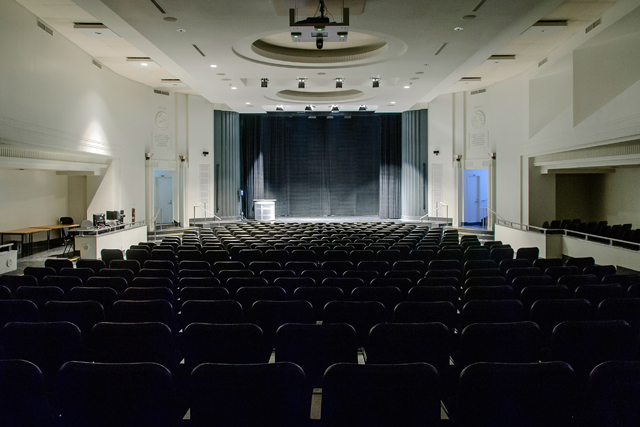
Here are a few small things that I learned about conferences from my very first:
Not everyone goes to every talk;
Not everyone arrives on time to hear the talks, but that doesn’t necessarily seem to be a problem;
There is a correlation between the continent of origin of the conference-goers and the location of the conference, which makes total sense. I imagine that if the conference were in Germany, there would probably have been more Europeans;
People do not necessarily expect undergraduates to present their work (as a first author, especially), nor to ask questions during talks;
It is an incredibly gratifying experience to be surrounded by people who are very much interested in the same kind of questions that you are. It acts as a strong motivation for coming back.
Considering what it meant for me to attend LabPhon, I vowed to myself to do everything that I could to make the most of it. I attended every talk, save two. I also spent a good deal of mental energy on concentrating on the material presented, in order to formulate good and thoughtful questions. Sometimes, a question is not necessarily a good one and it is not at all a good idea to ask a question for question’s sake. I did end up asking quite a few questions that I felt were appropriate and possible for the speaker to answer.
I also tried speaking with as many people as possible. I made friends with the “P” people at the Experimental Linguistics Research Hub at Carleton University. I learned what “S” (syntax/semantics) and “P” (phonetics/phonology) people are, and that I had been a “P” person this whole time…
I presented our poster on Friday, the 26th. I was worried that I hadn’t ordered the poster in time, but UQAM’s printing services were able to deliver quick results. Finding the printing room, however, was another ordeal. After around 30 minutes of searching and help from a security guard and from a librarian, I was able to find it. I didn’t know that UQAM is separated into two different campuses (no, the printing room I chose is not on the same campus as where the conference was held). A practical investment could be a poster tube and maybe choosing a printing room closer by. Next time.
LabPhon’s poster sessions evoked medieval bridge markets (think Ponte Vecchio): there were a lot of people, there was not an enormous amount of space, and a lot of people wanted to see a lot of things. Nonetheless, presenting a poster was a fulfilling experience. I learned that people are generally quite fascinated by anything to do with the Basque language, meaning that there were no breaks to be had during the entire hour-long session. There is a whole etiquette involved when it comes to posters. People will ask you something like “Could you guide me through your poster?”
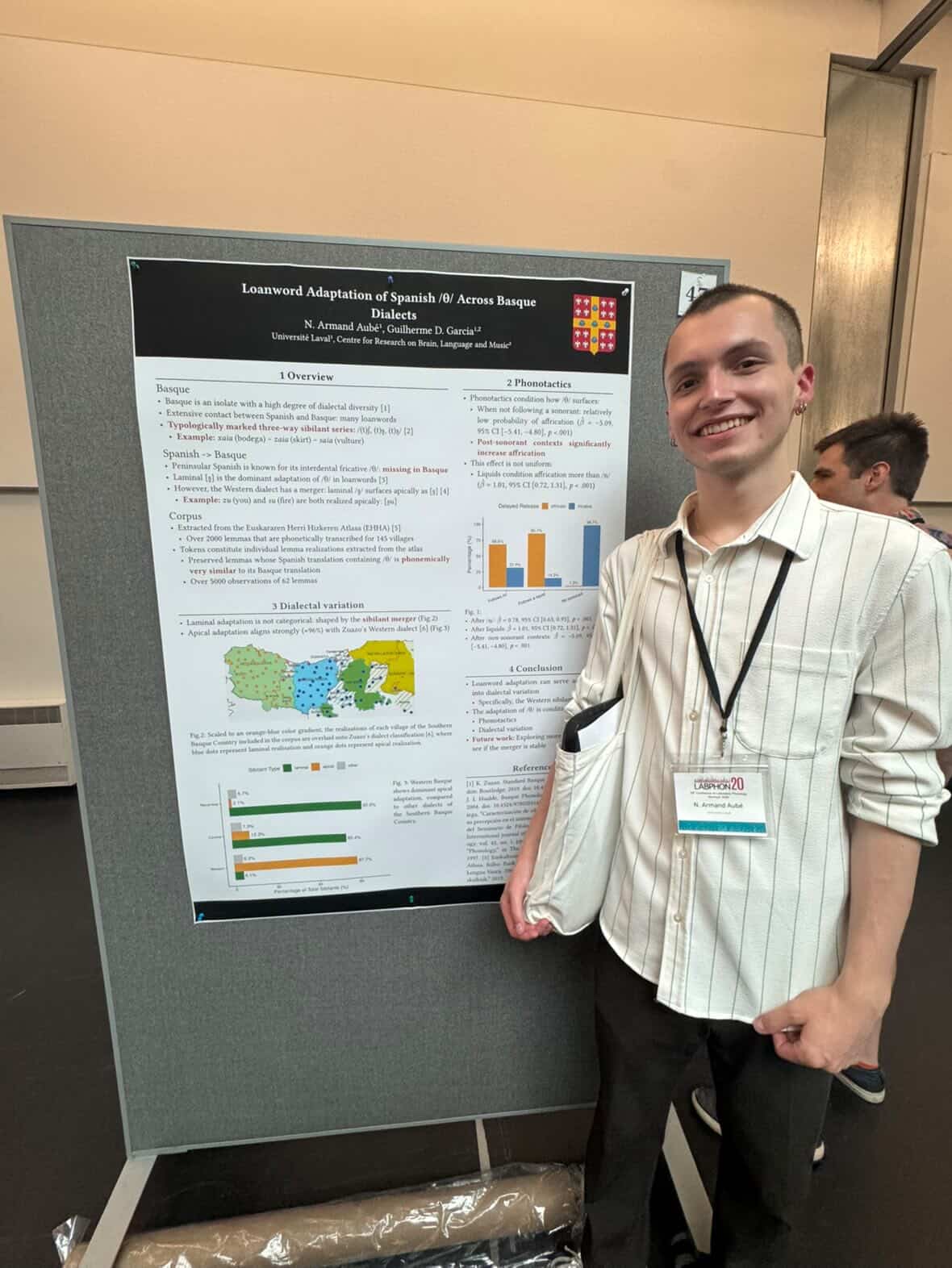
In hindsight, I should have practised beforehand. What results is a first run-through that contains too much information and lacks organization, and leaves you wondering whether or not the person in front of your poster, lightly nodding their head, is utterly lost and has defaulted to simply reading the contents of the poster itself. Yet, this first run-through appears to suffice for practice. By the second time someone asks this question, the speech is refined, clearer and more methodical.
On the last day of the conference, we had a final discussion, where conference-goers were free to ask questions about the conference. These included questions about the future of laboratory phonology, about whether or not there is too much “lab” and not enough “phon” in the presentations, and about the job market (especially for grad students), leading to a rather interesting discussion. The conference concluded with an announcement that LabPhon21 would be held in Cologne, Germany, in 2028.
19th Methods in Dialectology and Language Diversity
About a month later came the Methods conference. It was held from August 4th to August 7th in Vancouver, Canada (a little further from home this time). In my naïveté, I assumed that poster sizing was universal in linguistics as a whole. I was wrong, but thankfully, I checked the author guidelines a week beforehand, just to make sure. In fact, for this conference, posters are horizontal and A1-sized (LabPhon recommended vertical and A0-sized). It didn’t take long to make a version of the poster to fit these guidelines, but I did end up needing to cut a figure to make space.
The conference was entirely held at the University of British Columbia, which boasts a campus the size of a small town. Between mountains, ocean, and great weather, it was a marvellous place to visit.
During Methods, presenting a poster was a little “calmer” than at LabPhon. Set up in the same room where we ate lunch, we had about five posters per session (compare LabPhon’s 30 per hour). I noticed the same “Basque effect”, which meant that there was always someone at our poster. Most of those who visited our poster were phonologists, people I had met at LabPhon, or acquaintances I had met during the conference, always leading to fruitful discussions, after we had gone through the poster, of course.
Going to Methods showed me that not all conferences work the same way. I came away with fewer new names in my notebook than after LabPhon, but the conversations were of a different nature, and I had time to enjoy Vancouver itself between sessions. Methods provided us students with a mentor lunch, where we had the chance to pour our hearts out about our academic anxieties. I thank Dr. Rebecca Roeder and Nathalie Dion for their advice.
During the special Hawaiian session, I learned about Hawaiian’s status as a minoritized language. I was also made aware of the “debate” as to what we should call the varieties of revitalized Hawaiian. The nice part about these sessions is that there is a little bit for everyone in every session. We looked at phonetic contrasts over generations, but also took the time to discuss questions of linguistic legitimacy (particularly in the case of Hawaiian). Who gets to be a native speaker? Questions like these definitely evoke interesting discussions among different generations of researchers.
Conclusion
Looking back on these events, it is remarkable to me that a project that began as an undergraduate research project eventually led to two international conferences, two posters, and conversations with researchers from around the world.
I am particularly grateful to have had the opportunity to experience all of this early on in my academic career. The experience has made the prospect of continuing in research on phonology and linguistic variation considerably more exciting, and I hope that this will not be the last time I find myself standing beside a poster, explaining why Basque speakers do (or do not) adapt a Spanish sound in a particular way.
As for future work, the EHHA has very interesting data worth exploring. More specifically, all transcriptions include accentual data. The words transcribed in the Atlas could be useful if we would like to compare them to newer prosodic data; to better understand a language whose prosodic systems are in a period of upheaval, possibly due to the influence of the majority language. A year from now, the third Euskal Mundu Biltzarra will be held in Bilbao: maybe the exploration of this prosodic data could be made into an abstract.
I plan to continue working on the intersections between Basque and Spanish. These projects not only focus on Basque, but involve my intention to study the phonological interactions between majority and minority(ized) languages. This is one of the themes that I wish to make central in the research career that I seek to develop. For instance, my Master’s project, planned for 2027-2028, will focus on prosodic influence from Spanish on Northern Bizkaian Basque, under the supervision of Dr. Gorka Elordieta. Studying these influences allows us to monitor the vitality of minoritized languages and understand how they change. In this case, the influence of Spanish on Basque is widespread, and it is politically and socially relevant for Basque-speaking society.
Copyright © Guilherme Duarte Garcia